Abu Dhabi television, part of Abu Dhabi Media, is a leading Emirati television channel launched in 1969, with its modern format established in 2000 and rebranded as Abu Dhabi Al Oula in 2008.
Broadcasting primarily in Arabic, it offers a diverse mix of news, dramas, talk shows, cultural programs, and documentaries, reflecting the UAE’s heritage and modern achievements.
Popular programs include Ana wa Binti and Min Wahi Al-Tasreeh, appealing to Arab families across the Middle East and beyond.
As a free-to-air channel, it is accessible via major satellites and streams live on www.adtv.ae and YouTube.
This guide provides the latest frequencies for Abu Dhabi television on satellites as of June 2026, a step-by-step tuning process, reception tips, and an overview of its engaging content.
Why Watch Abu Dhabi television?
-
Diverse Content: Offers news, dramas, cultural, and religious programs, catering to varied interests.
-
Free-to-Air Access: Available without subscription on satellites and online platforms.
-
High-Quality Broadcasts: Provides HD and SD options for clear, immersive viewing.
-
Cultural Focus: Showcases Emirati heritage and modern UAE developments, resonating with Arab audiences.
-
Global Reach: Broadcasts to the Middle East, North Africa, Europe, and beyond, with streaming for worldwide access.
Abu Dhabi television Satellite Frequencies
To tune into Abu Dhabi television, you need accurate frequency, signal alignment, baud rate, and FEC (Forward Error Correction) settings for your satellite decoder.
|
Satellite |
Frequency |
Polarization |
Symbol Rate |
FEC |
Coverage |
Details |
|---|---|---|---|---|---|---|
|
Nilesat 201/Eutelsat 7 West A (7.0° W) |
11823 MHz |
Vertical (V) |
27500 kS/s |
5/6 |
Middle East, North Africa |
HD, DVB-S2, strong in UAE, Egypt, Saudi Arabia. Named Abu Dhabi television HD. |
|
Arabsat (Badr 4/8) (26.0° E) |
11804 MHz |
Horizontal (H) |
27500 kS/s |
3/4 |
Middle East, North Africa |
SD, DVB-S, reliable in Qatar, Jordan, Kuwait. Named Abu Dhabi television. |
|
Hot Bird 13B/C/D (13.0° E) |
11747 MHz |
Vertical (V) |
27500 kS/s |
3/4 |
Middle East, Europe |
SD, DVB-S, available in parts of Europe and MENA. Named Abu Dhabi television. |
Key Information
-
Satellite Coverage: Abu Dhabi television broadcasts on Nilesat, Arabsat (Badr), and Hot Bird, ensuring wide coverage across MENA and Europe. No confirmed frequencies are available on Yahsat (52.5° E) or Es’hail 2 (26.0° E) as of June 2026. Claims of Abu Dhabi television on these satellites are outdated or confused with other channels.
-
Frequency Accuracy: Avoid obsolete frequencies like 12226 MHz (Horizontal) or 12467 MHz (Vertical) on Nilesat, which are no longer active for Abu Dhabi television. The table over provides verified settings.
-
Global Access: Signals may weaken outside MENA (e.g., Asia or the Americas). Stream live on www.adtv.ae or YouTube for worldwide access.
-
Free-to-Air Status: Abu Dhabi television is unencrypted, requiring no subscription, ensuring accessibility inside satellite footprints.
Tips for Strong Reception
To enjoy Abu Dhabi television with clear, uninterrupted viewing, follow these practical tips for optimal satellite reception:
-
Dish Size: Use a 60-80 cm dish for Nilesat and Arabsat in MENA (e.g., Abu Dhabi, Cairo, Riyadh).
-
For Hot Bird in Europe, a 70-100 cm dish is recommended. In fringe areas (e.g., northern Europe or Central Asia), a 90-120 cm dish enhances signal strength.
-
Precise Dish Alignment: Point your dish to Nilesat (7.0° W), Arabsat (26.0° E), or Hot Bird (13.0° E) using a satellite finder or apps like DishPointer or SatFinder. Ensure no obstructions block the signal.
-
LNB Selection: Install a Universal Ku-band LNB (9.75/10.6 GHz) compatible with DVB-S for Arabsat and Hot Bird, and DVB-S2 for Nilesat HD broadcasts. Confirm decoder compatibility.
-
Signal Quality: Aim for 70% or higher signal quality (98% is optimal) on your decoder’s signal meter to prevent pixelation. Adjust LNB skew for peak performance.
-
Weather Protection: Ku-band signals may weaken during heavy rain. Secure your dish and check LNB caps for water damage to maintain stability.
-
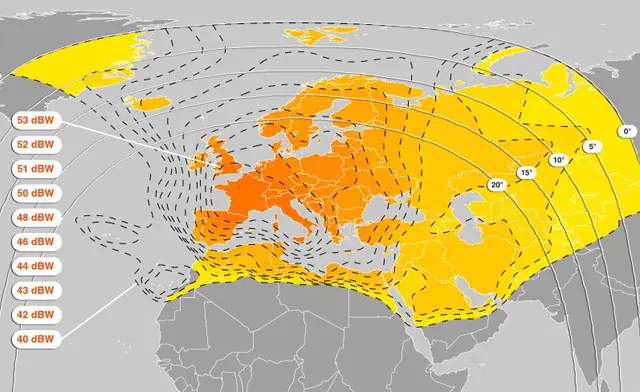
Coverage Check: Verify your location is inside the satellite’s beam using coverage maps on www.dishpointer.com or www.satbeams.com.
Tuning Abu Dhabi television on Your Receiver
Adding Abu Dhabi television to your satellite decoder is straightforward with these steps, compatible with most receivers (e.g., Strong, Humax, Starsat), though menu labels may vary slightly.
-
Access the Menu:
-
Press “Menu” or “Settings” on your remote.
-
Navigate to “Installation,” “Channel Search,” or “Antenna Setup.”
-
-
Select Manual Scan:
-
Choose “Manual Scan,” “Manual Installation,” or “Add Transponder.”
-
Select “Add TP” or “Edit Transponder” if prompted.
-
-
Choose Your Satellite:
-
Select Nilesat (7.0° W), Arabsat (Badr 4/8, 26.0° E), or Hot Bird (13.0° E) from the satellite list.
-
If not listed, manually enter the orbital position.
-
-
Enter Transponder Settings:
-
Refer to the frequency table over and input the settings for your chosen satellite (e.g., 11823 MHz, Vertical, 27500 kS/s, 5/6 for Nilesat).
-
Double-check entries for accuracy.
-
-
Run the Scan:
-
Press “Scan,” “Search,” or “OK” to start the search.
-
Select “FTA Only” or “All Channels” to include free-to-air channels.
-
Wait 1-3 minutes for the search to complete.
-
-
Save Channels:
-
Press “Save” or “OK” to store the scanned channels.
-
Abu Dhabi television will appear as “Abu Dhabi television HD” or “Abu Dhabi television” in your channel list.
-
-
Fine-Tune for Strong Signal:
-
If the signal is weak or the channel is missing, adjust the dish’s azimuth and elevation while monitoring the signal meter.
-
Check LNB skew and cables for 70-98% signal strength.
-
-
Test the Broadcast:
-
Locate Abu Dhabi television in your channel list and select it to confirm clear playback.
-
If issues persist, recheck settings or consult a professional installer.
-
Receiver Tips:
-
For Strong receivers (e.g., SRT 4950), enable “LNB Power” in the “Transponder” menu.
-
For Humax or Starsat, set LNB to “Universal” for Ku-band.
-
Default PINs (e.g., 0000, 1234) may be required; refer to your manual.
Abu Dhabi television’s Engaging Programming
Abu Dhabi television delivers a comprehensive lineup of programs, blending news, entertainment, and cultural content, appealing to Arab families. Key highlights include:
Top Programs
-
Ana wa Binti: A talk show hosted by Egyptian actor Sherif Mounir and his daughter, featuring celebrity interviews and family-oriented discussions.
-
Min Wahi Al-Tasreeh: A religious program presented by Sheikh Wassim Yousef, simplifying Quranic interpretations and Islamic rulings.
-
Yalla Social: A program exploring trending topics on social media, engaging younger audiences.
-
Min Rahiq Al-Iman: Hosted by Sheikh Wassim Yousef, it addresses Islamic misconceptions in a concise format.
-
Documentaries: Short films showcasing the UAE’s history, tourism, and cultural heritage.
Content divisions
-
News: Bulletins every three hours covering local, regional, and global events.
-
Dramas: Popular Gulf, Egyptian, and Syrian series, especially during Ramadan.
-
Talk Shows: Cultural, social, and political discussions with expert guests.
-
Cultural: Programs highlighting Emirati traditions and modern achievements.
-
Entertainment: Family-friendly shows and Arabic films.
How to Read a Satellite Coverage Map
- Understand the satellite footprint and signal strength contours.
- Check the elevation and azimuth angles for your specific location.
- Use maps to identify potential obstructions affecting reception.
- Consider regional variations in signal quality before installation.
How to Accurately Configure DiSEqC Motor Settings
- Set your geographic coordinates in the decoder (USALS installation).
- Align the dish to the true south satellite first.
- Test movement to multiple satellites to ensure correct tracking.
- Fine-tune motor limits and positions for accuracy.
Using Multi-Satellite Reception Techniques
- Install DiSEqC switches to connect multiple LNBs to a single decoder.
- Use motorized dishes to automatically track different satellites.
- Configure decoder settings to switch between satellites efficiently.
- Ensure all LNBs are properly aligned for optimal signal strength.
- Consider multi-feed setups for simultaneous reception of several satellites.
Using Dual Dishes to Receive Multiple Satellites
- Install two dishes to target different satellites simultaneously.
- Use DiSEqC switches to connect both dishes to a single decoder.
- Ensure both dishes are properly aligned to their respective satellites.
- Consider multi-feed solutions for compact installations.
Best Apps to Track Satellites on Your Phone
- Use satellite tracking apps to find azimuth and elevation angles.
- Access real-time satellite positions and footprints.
- Receive notifications for satellite launches or channel changes.
- Some apps provide augmented reality views to assist dish alignment.
Using Multi-Satellite Reception Techniques
- Install DiSEqC switches to connect multiple LNBs to a single decoder.
- Use motorized dishes to automatically track different satellites.
- Configure decoder settings to switch between satellites efficiently.
- Ensure all LNBs are properly aligned for optimal signal strength.
- Consider multi-feed setups for simultaneous reception of several satellites.